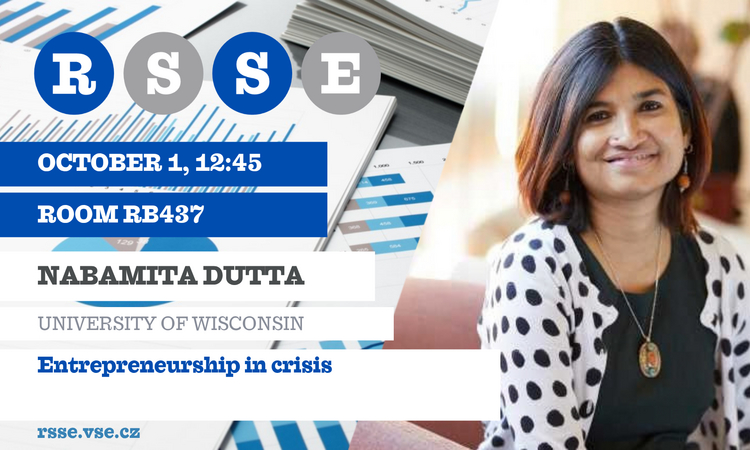
RSSE: Nabamita Dutta (University of Wisconsin) Entrepreneurship in crisis
| Začátek: | čtvrtek 1. října 2026, 12:45 |
|---|---|
| Konec: | čtvrtek 1. října 2026, 14:15 |
| Jazyk události: | angličtina |
| Místo konání: | RB 437 |
| Online událost: | Microsoft Teams |
| Kontaktní osoba: | Lubomír Cingl |
| Tagy: | #doktorandi #phd #phdstudents #research #rsse #seminars #zamestnanci |
It is our pleasure that Nabamita Dutta (University of Wisconsin) will present on Thursday, October 1, 2026, at 12:45 in room RB437 about the topic “Entrepreneurship in crisis”.
Registration is not required and anyone who would like to attend is warmly invited.
It is also possible to participate online via MS Teams at this link. In case of any connection issues, please contact lubomir.cingl@vse.cz.
ABSTRACT: This paper examines how political transitions—revolutions and coups—affect entrepreneurial activity, using a global panel of 148 countries (2001–2020) and a staggered difference-in-differences design. Existing theories offer competing predictions: political upheaval may deter entrepreneurship through uncertainty and weakened property rights, or stimulate it by dismantling entrenched rent-seeking networks. The results show substantial heterogeneity: violent and nonviolent revolutions both reduce new business formation in the anticipatory and contemporaneous periods, but violent revolutions rebound strongly two years later as rent-seeking networks collapse, while nonviolent revolutions show persistent negative effects despite long-run institutional gains. Coups show sharper contrasts—military coups harm entrepreneurship through institutional deterioration, while civilian coups boost it by disrupting politically connected incumbents while preserving institutional continuity, with successful coups recovering faster than failed ones. Overall, there is no uniform effect of political transitions on entrepreneurship; outcomes depend on the interaction between regime uncertainty, institutional disruption, elite rotation, and time.
BIO: Nabamita Dutta is a Professor of Economics and Co-Director of Menard Family Initiative at the University of Wisconsin-La Crosse. Her main research interests hinge at the intersection of new institutional economics and economic development with emphasis on entrepreneurship, political economy, and economics of gender.