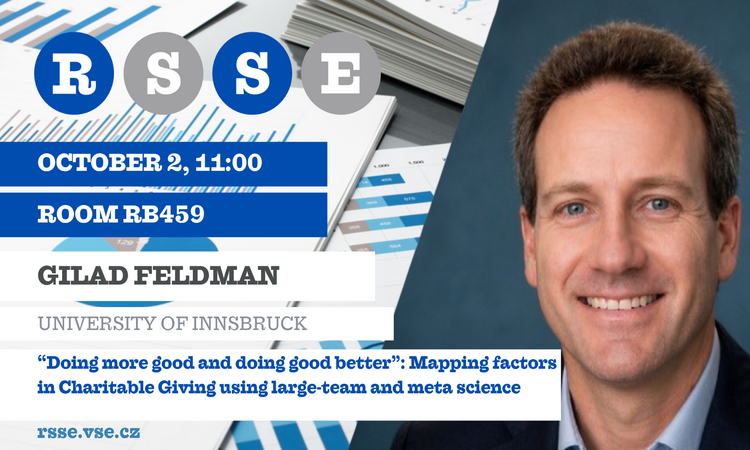
RSSE: Gilad Feldman (University of Innsbruck) “Doing more good and doing good better”: Mapping factors in Charitable Giving
| Začátek: | pátek 2. října 2026, 11:00 |
|---|---|
| Konec: | pátek 2. října 2026, 12:30 |
| Jazyk události: | angličtina |
| Místo konání: | RB 459 |
| Online událost: | Microsoft Teams |
| Kontaktní osoba: | Lubomír Cingl |
| Tagy: | #doktorandi #phd #phdstudents #research #rsse #seminars #zamestnanci |
It is our pleasure that Gilad Feldman (University of Innsbruck) will present on Friday, October 2, 2026, at 11:00 in room RB459 about the topic ““Doing more good and doing good better”: Mapping factors in Charitable Giving using large-team and meta science”.
Registration is not required and anyone who would like to attend is warmly invited.
It is also possible to participate online via MS Teams at this link. In case of any connection issues, please contact lubomir.cingl@vse.cz.
ABSTRACT: How do people decide between charities? Building on a seminal book chapter (Baron and Szymanska, 2011), our replications and extensions (e.g., Chan and Feldman,2025), and recent work on (in)effective altruism, I ran a many-designers crowd-sourcing mapping project conducted across three cohorts in the years 2023-5. 22 teams generated candidate factors that they thought were most likely to impact charitable giving. The methodological design was the same for testing all hypotheses: Participants made donation allocation choices between two charities that were similar in effectiveness and provided information yet differing on one focal attribute. In each of the three cohorts, hypotheses were pre-registered, and tested with U.S. Americans on Prolific. We tested 195 hypotheses (2023: 104; 2024: 31; 2025: 60), with per-comparison samples ranging from 109 to 195 participants. The tested factors spanned broad domains, including risk and certainty, transparency, credibility, cause urgency, geographic scope, donation structure, governance, beneficiary characteristics, and allocation rules. Our findings suggest that charitable giving is sensitive to a wide range of contextual features, with many of the factors showing very strong effects, some as high as Cohen’s d = 2.24.
BIO: Gilad Feldman is an assistant professor at the University of Innsbruck’s Department of Banking and Finance. His research focuses on judgment and decision-making, behavioral economics, heuristics and biases, choice and agency, morality, and personal values. He also studies helping and giving, and how to address urgent global challenges. Methodologically, he is committed to open science, meta-science, and large-team collaboration, with a recent focus on pre-registered replications and meta-analyses, as well as AI-assisted research tools. He runs Scirenity, which aims to support better science.